
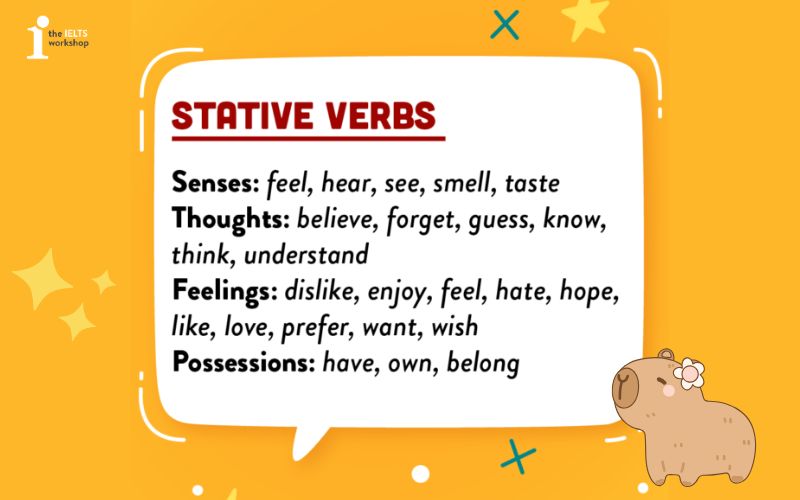
We call some verbs, e.g. ‘like’, ‘love’ and ‘hate’, STATIVE verbs because they refer to ‘states’.
A state has no beginning and no end.
We usually use these verbs only in the simple, not in the continuous form.
EXERCISE 1
Look at the table and then complete the sentences below:
✔ = like (s)
X = don’t/doesn’t like
1. Shelley ______________ fish and chips but she _______________ pizza.
2. Martin and Viv _____________ watching videos.
3. My parents __________ it when I make a lot of noise.
4. I _____________history and Peter _____________it, either.
5. I _____________ holidays by the sea but my mum __________ to go skiing.
EXERCISE 2
Now complete this table, and then ask your partner about his/her food preferences:
| Favourite Food Chart | ||
| me | My partner | |
| Like(s) | ||
| Like(s) a lot | ||
| Don’t/ doesn’t like | ||
| Hate(s) | ||
Now complete the sentences, as in the example:
e.g. I like hamburgers but my partner like souvlaki.
1. I don’t like _____________ and I hate _______________.
2. My partner doesn’t like ___________ but he/she likes __________ a lot.
3. I prefer __________to___________.
EXERCISE 3
The verbs ‘think’, ‘understand’, ‘believe’ and ‘know’ are also commonly used in simple tenses only:
E.G. I know your cousin. I didn’t understand that book on astrophysics.
Fill the gaps in the following sentences with the simple present or simple past of the correct verb:
1. I__________ he’s telling lies. Do you_________him?
2. We____________ every word you said.
3. She________ the names of all the members of the football team.
4. I_________ not________ if that’s the right decision.
What ______you_________?
5. The judge________ that the young man was telling the truth, and let him go free.